Ruhla 1929 – Space Control – Sigmund Jähn – The First German in Space, 1978
Caliber: Automatic Citizen-Miyota 8315, 21 jewels
Watchcase: stainless steel, polished
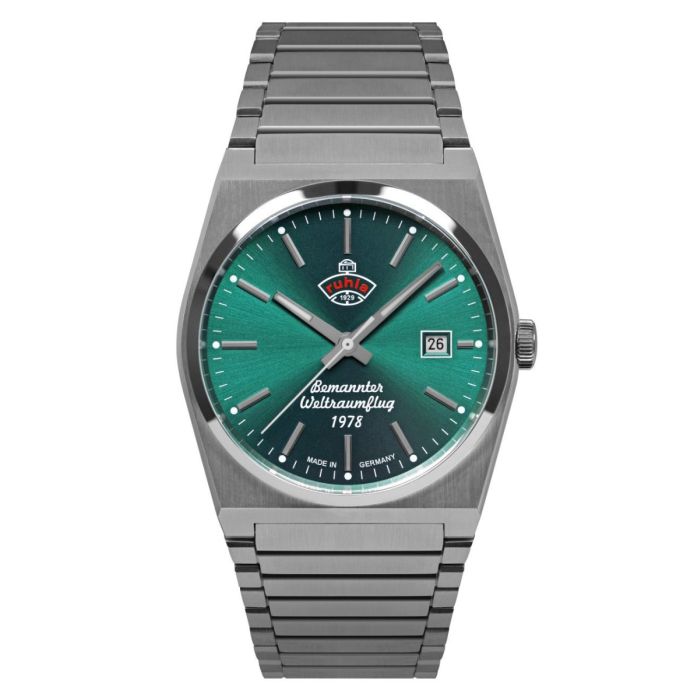
Dial: Darkgreen finish with silver-colored numerals/indices and luminous hands
Diameter: 40 mm
Height: 12 mm
Ruhla 1929 – Space Control – Sigmund Jähn – The First German in Space, 1978
NEW AT POLJOT24.DE – DISCOVERED AT WATCHTIME DÜSSELDORF!
During my visit to this year's WatchTime watch exhibition in Düsseldorf, I discovered this extraordinary reinterpretation of a historic Ruhla wristwatch and brought the first examples back to Munich for my customers.
The Ruhla 1929 Space Control "Sigmund Jähn 1978" is a truly special mechanical wristwatch. It commemorates one of the most important milestones in German space exploration: the first spaceflight by a German on August 26, 1978.
With its darkgreen dial, distinctive 1970s-inspired stainless steel case and integrated stainless steel bracelet, this watch combines historical design with modern mechanical watchmaking.
Inside beats the reliable Japanese Citizen-Miyota 8315 automatic movement, featuring 21 jewels and an impressive 60-hour power reserve. Scratch-resistant sapphire crystal, water resistance to 10 bar and an exhibition caseback revealing the mechanical movement complete its impressive specifications.
A watch from Thuringia, Germany, commemorating a journey that once reached far beyond our planet.
August 26, 1978 – Sigmund Jähn Becomes the First German in Space
On August 26, 1978, a new chapter in German space history began. From the Baikonur Cosmodrome, the Soviet spacecraft Soyuz 31 lifted off carrying two cosmonauts: experienced Soviet commander Valery Bykovsky and East German research cosmonaut Sigmund Jähn.
Born in 1937 in the Vogtland region of Saxony, Jähn became the first German to leave Earth and travel into space.
The mission's destination was the Soviet space station Salyut 6. There, Jähn conducted numerous scientific experiments as part of the international Interkosmos programme.
These included medical, biological and materials science investigations, as well as observations of Earth from space.
One particularly interesting experiment involved the MKF-6M multispectral camera, developed in East Germany, which was used to photograph and study the Earth's surface.
After 7 days, 20 hours and 49 minutes in space and a total of 124 orbits around Earth, Sigmund Jähn returned safely on September 3, 1978, together with Valery Bykovsky aboard the Soyuz 29 return capsule.
His historic flight made him one of the best-known figures in German space exploration and remains an important milestone in the history of human spaceflight.
A Ruhla Wristwatch Travelled into Space in 1978
What many watch enthusiasts may not know is that the traditional watchmaking industry of Ruhla, a small town in Thuringia, Germany, was also connected to this historic space mission.
For the occasion, the former East German VEB Uhren- und Maschinenfabrik Ruhla manufactured a special wristwatch bearing the inscription "Bemannter Weltraumflug", meaning "Manned Spaceflight".
These watches featured a distinctive brown dial with a fascinating gradient, transitioning from a lighter centre to darker tones around the edges. This unusual colour scheme was characteristic of the late 1970s.
Four of these special Ruhla watches travelled into space aboard the Soyuz 31 mission. Three were intended as gifts for Soviet cosmonauts aboard the space station, while another was worn by Sigmund Jähn himself.
The historic original watches were equipped with an electronic quartz movement manufactured in Ruhla.
The modern Space Control takes a deliberately different approach, combining the original design with a contemporary mechanical automatic movement.
The Ruhla 1929 Space Control "Sigmund Jähn 1978" is therefore much more than an ordinary retro-style watch. It is a tribute to a genuine German timepiece that actually travelled into space.
The Dial – A Journey Back to the 1970s
Darkgreen dial.
Applied silver-coloured hour markers and matching hands enhance the elegant appearance. Luminous inserts on the hands improve readability in low-light conditions.Below the centre of the dial is the historic inscription "Bemannter Weltraumflug 1978" – "Manned Spaceflight 1978" – while the traditional Ruhla logo proudly recalls the watch's German heritage.
A practical date window is positioned at 3 o'clock. The carefully executed minute track and classic dial layout preserve the distinctive character of the original watch.
The Movement – Citizen-Miyota 8315 with a 60-Hour Power Reserve
Inside the Ruhla Space Control operates the modern Japanese Citizen-Miyota calibre 8315, a mechanical automatic movement with 21 jewels.
Part of Miyota's proven 8000-series movement family, the calibre 8315 is known for its robust construction, dependable engineering and particularly generous power reserve.
Operating at 21,600 vibrations per hour, equivalent to 3 Hz, the movement beats at a traditional mechanical frequency.
Its most practical feature is the impressive 60-hour power reserve.
If the watch is taken off on Friday evening, for example, it can continue running until Monday morning, provided it was sufficiently wound beforehand.
The movement also features a hacking seconds function for precise time setting, quick-set date adjustment and the possibility of manually winding the mainspring using the crown.
Through the transparent sapphire crystal caseback, the fascinating mechanical movement can be admired.
A particularly attractive detail is the decorated rotor, bearing the inscriptions "Automatic", "21 Jewels" and "Fine German Wristwatches".
The combination of historical design and modern Japanese automatic technology makes this Ruhla an excellent choice for everyday wear as well as an interesting collector's watch.
Classic Stainless Steel Case with Integrated Bracelet
The distinctive stainless steel case deliberately recalls the sporty yet elegant wristwatches of the 1970s.
With a diameter of 40 mm, the Space Control offers contemporary dimensions while retaining the proportions and character of its historical inspiration.
The striking tonneau-shaped case, with its brushed surfaces and polished bezel, gives the watch a highly individual appearance.
Particularly attractive is the integrated stainless steel bracelet, which flows almost seamlessly into the case.
This style of construction was especially popular during the 1970s and has experienced a remarkable revival in recent years.
The bracelet is equipped with a secure clasp and perfectly complements the watch's sporty, technical character.
A durable sapphire crystal protects the dial against scratches, while water resistance to 10 bar / 100 metres makes the watch well suited to everyday use.
Made in Germany – The Watchmaking Heritage of Ruhla
The history of watchmaking in Ruhla stretches back to the 19th century.
Over many decades, this small town in Thuringia developed into one of Germany's most important centres of watch and clock manufacturing.
During the East German era in particular, the Ruhla watch factories produced millions of wristwatches and movements.
These reliable and affordable timepieces became widely known far beyond the borders of Thuringia.
Today, the tradition continues at the historic manufacturing location.
Watches bearing the Ruhla 1929 name are produced in Ruhla, combining the heritage of the former watch factories with modern manufacturing methods and contemporary technology.
The year 1929 refers to the historic factory building in which watches are once again being manufactured today.
Technical Specifications – Ruhla 1929 Space Control Sigmund Jähn 1978
Manufacturer: Ruhla 1929 – Made in Germany
Model: Space Control "Sigmund Jähn 1978"
Reference: 4660M4
Movement: Citizen-Miyota 8315, mechanical automatic
Jewels: 21
Frequency: 21,600 vibrations per hour (3 Hz)
Power reserve: Approximately 60 hours
Winding: Automatic and manual winding
Functions: Hours, minutes, central seconds, date
Hacking seconds: Yes
Quick-set date: Yes
Case material: Stainless steel
Case shape: Classic tonneau shape with integrated bracelet
Case finish: Brushed with polished accents
Case diameter: 40 mm
Case thickness: Approximately 12 mm
Dial: Darkgreen with historic Ruhla logo and "Bemannter Weltraumflug 1978" inscription
Hour markers: Applied, silver-coloured
Hands: Silver-coloured with luminous inserts
Crystal: Sapphire crystal
Caseback: Sapphire exhibition caseback with commemorative spaceflight engravings
Water resistance: 10 bar / 100 metres
Bracelet: Integrated stainless steel bracelet
Bracelet attachment width: 22 mm according to manufacturer specifications
Clasp: Safety clasp
Manufacturing: Made in Germany, produced in Ruhla
New at Poljot24.de – Personally Discovered at WatchTime Düsseldorf
I personally discovered this remarkable Ruhla Space Control during my visit to the WatchTime exhibition in Düsseldorf.
The combination of German watchmaking history, Sigmund Jähn's historic spaceflight and the fascinating vintage-inspired dial immediately caught my attention.
That is why I decided to bring the first examples back from the exhibition for my customers.
At Poljot24.de, we have specialised in distinctive mechanical watches since 1992.
We place great importance on careful final inspection, personal customer service and dependable support from our Munich-based business.
The Ruhla 1929 Space Control "Sigmund Jähn 1978" is much more than an ordinary automatic wristwatch.
It commemorates the first German in space, celebrates the fascinating heritage of the Thuringian watchmaking industry and recalls an extraordinary wristwatch that actually travelled into the cosmos in 1978.
Ruhla 1929 Space Control – Where German Watchmaking Heritage Meets the History of Space Exploration.
Poljot24.de – Watches With History.